
Psychological assessment: understanding the whole picture
A psychological assessment uses standardised tests, questionnaires, observation and a detailed interview to understand how a person thinks, learns, feels and behaves. It helps answer specific questions, such as why a child is struggling at school, whether a pattern of difficulties fits autism or ADHD, or whether memory changes in an older parent need attention.
At Headspace Mind Clinic, our RCI-registered clinical psychologists carry out a wide range of assessments used in India, from intelligence and developmental tests to personality questionnaires and projective tests such as the Rorschach, for children, adolescents and adults, at all three of our clinics. The results are explained to you and used to plan treatment.
For education only. This page explains a treatment in general terms. It is not medical advice and cannot replace a consultation with a qualified doctor who knows your history. Whether a treatment suits you can only be decided after an assessment. If you are in danger or think you may harm yourself, call 112 or Tele-MANAS 14416 now.
Assessments we offer
Depending on the question you want answered, an assessment may look at:
- Intelligence (IQ) and development, for children and adults
- Autism spectrum and ADHD
- Specific learning difficulties (reading, writing, maths)
- Memory and thinking, including assessment for dementia
- Personality, using questionnaires and projective tests
- Mood, anxiety, OCD and other symptoms, using structured scales
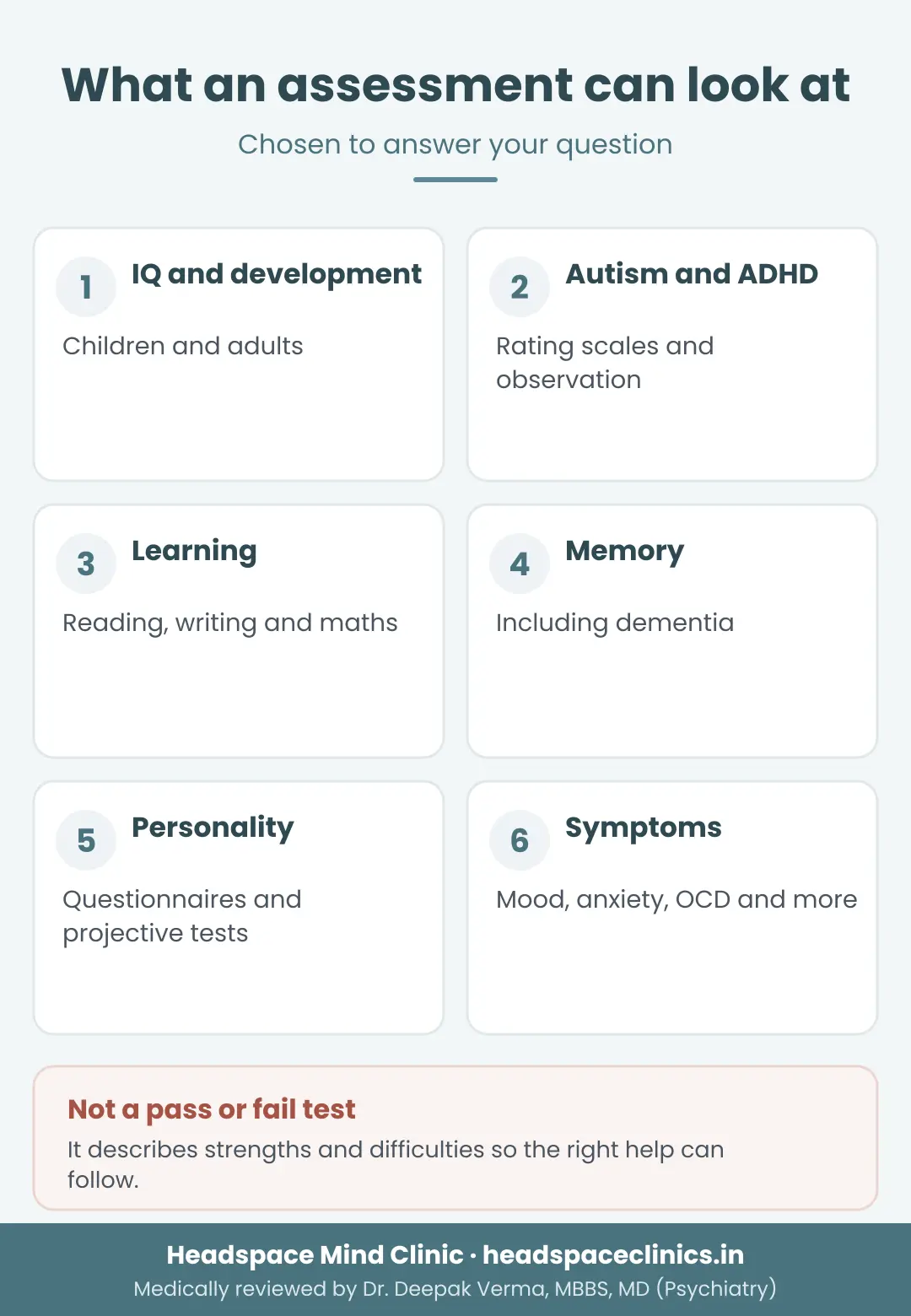
What a psychological assessment can look at. Tap the image to enlarge.
Tests commonly used at our clinics
The psychologist chooses the tests for each person, depending on age, language and the question being asked. Examples of tests widely used in India that we offer include:
- Intelligence and development: Malin’s Intelligence Scale for Indian Children (MISIC), Binet-Kamat Test, Bhatia’s Battery of Performance Tests, Wechsler scales, Raven’s Progressive Matrices, Seguin Form Board, Vineland Social Maturity Scale (VSMS) and the Developmental Screening Test (DST)
- Autism and ADHD: Indian Scale for Assessment of Autism (ISAA), Childhood Autism Rating Scale (CARS) and ADHD rating scales such as the Conners scales
- Learning difficulties: NIMHANS Index for Specific Learning Disabilities
- Personality questionnaires: MMPI, 16PF, Millon Clinical Multiaxial Inventory (MCMI) and Eysenck Personality Questionnaire
- Projective tests: Rorschach inkblot test, Thematic Apperception Test (TAT), Children’s Apperception Test (CAT), Draw-a-Person and House-Tree-Person tests, and Sentence Completion Test
- Memory and thinking: Mini-Mental State Examination (MMSE) and its Hindi version (HMSE), Montreal Cognitive Assessment (MoCA), Addenbrooke’s Cognitive Examination (ACE-III), PGI Memory Scale and PGI Battery of Brain Dysfunction
- Symptom scales: for example the Yale-Brown Obsessive Compulsive Scale (Y-BOCS), Hamilton depression and anxiety scales and the Beck Depression Inventory
Not every assessment needs all of these. A focused assessment usually uses a few well-chosen tests.
When is a psychological assessment useful?
An assessment is most useful when there is a clear question. Common reasons include:
- a child who is struggling with learning, attention or behaviour at school, or whose development seems different from other children of the same age (see child psychologist and autism assessment and support)
- an adult who has always found focus, organisation or social situations hard and wants to understand why
- forgetfulness or confusion in an older family member (see dementia and memory problems)
- long-standing difficulties with emotions and relationships (see personality disorders)
- when the diagnosis is unclear and the psychiatrist wants more information before deciding on treatment
An assessment is not a pass-or-fail test. Its purpose is to describe a person’s strengths and difficulties clearly, so the right help can follow.
How an assessment builds the picture
No single test gives a diagnosis. The psychologist combines several sources: a detailed history from you (and, for children, from parents and sometimes teachers), observation, standardised tests chosen for the question being asked, and rating scales. The results are compared with age-appropriate norms and read together with the psychiatrist’s clinical assessment. Related pages:
Who carries out assessments
Children and adolescents
Assessment and support
Attention difficulties in adults
Memory concerns in older adults
Long-standing patterns
What happens during an assessment
The usual steps.
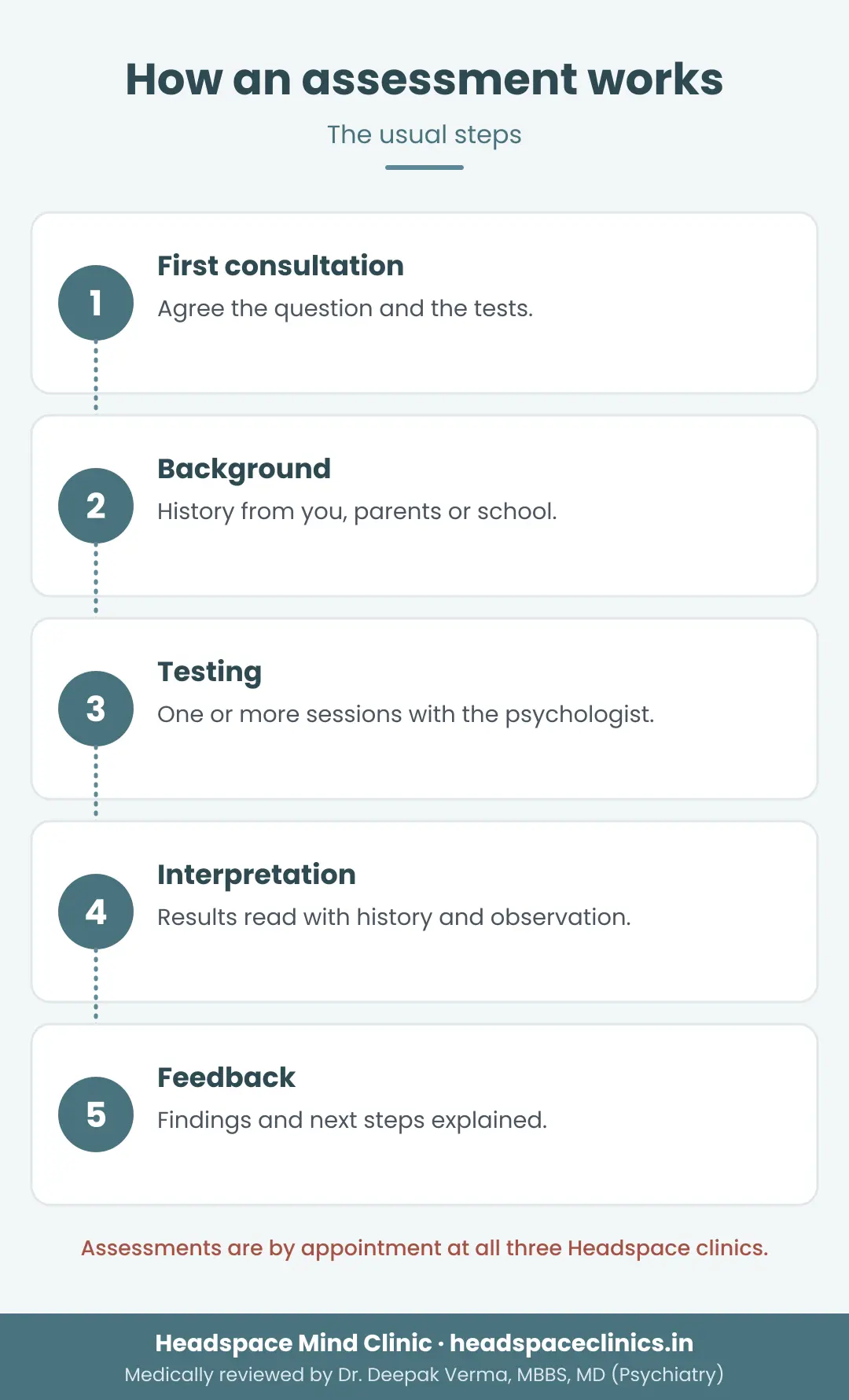
How a psychological assessment works. Tap the image to enlarge.
First consultation. We talk about your concerns and the question the assessment should answer, and decide which tests are needed.
Background information. We take a detailed history. For children, parents describe development, school and behaviour, and school reports help.
Testing sessions. The tests are done face to face with the psychologist. Depending on the assessment, this may take one or more sessions.
Scoring and interpretation. The psychologist scores the tests and considers the results alongside the history and observations.
Feedback. The findings are explained to you in plain language, with recommendations for treatment, therapy or support at school or work.
If medicines or a medical opinion may be needed, our psychiatrist reviews the findings with you.
Do I need an assessment?
Not everyone does. Many concerns can be understood well in a consultation and treated directly. An assessment is recommended when the answer will change what happens next, for example the type of therapy, support at school, or a diagnosis that needs careful confirmation.
If you are not sure, start with a consultation with our psychiatrist or a clinical psychologist, who can advise whether testing would help.
Assessments at Headspace Mind Clinic
Assessments are carried out by our RCI-registered clinical psychologists, including Pooja Sharma (children, adolescents and adults), Dr. Tanuja Bhardwaj and Surmeet Kaur, working with our psychiatrist Dr. Deepak Verma. Assessments are available at all three of our clinics by appointment.
मनोवैज्ञानिक जाँच क्या है? (Psychological assessment in Hindi)
मनोवैज्ञानिक जाँच (साइकोलॉजिकल असेसमेंट) में क्लिनिकल साइकोलॉजिस्ट मानक टेस्ट, प्रश्नावली, बातचीत और अवलोकन से यह समझते हैं कि व्यक्ति कैसे सोचता, सीखता और व्यवहार करता है। इससे बच्चों में पढ़ाई या विकास की कठिनाइयाँ, ऑटिज़्म, बुज़ुर्गों में याददाश्त की समस्या, या व्यक्तित्व से जुड़ी कठिनाइयों को समझने में मदद मिलती है। यह जानकारी केवल शिक्षा के लिए है। अपॉइंटमेंट के लिए कॉल करें: +91 99711 66040

Founder of Headspace Mind Clinic. Dr. Verma sees patients at our Paschim Vihar, Rohini and Narela clinics. About our psychiatry service →
Three clinics in West and North Delhi
Psychiatrist consultation fee: ₹1,800 at Paschim Vihar and Rohini, ₹500 at Narela. All appointments are scheduled; please call or book online.
GH-14/49, near Bosco Public School, Paschim Vihar, Delhi 110087
+91 99711 66040
C-8/273, near Gurudwara, Sector 8, Rohini, Delhi 110085
+91 90990 97381
48/1, Plot no. 3, Singhu Border Road, Krishna Colony, Narela, Delhi 110040
+91 74530 00444
Frequently asked questions
A psychometric test is a single standardised tool, such as an IQ test. A psychological assessment combines several tests with a detailed history and observation, and is interpreted by a clinical psychologist.
An RCI-registered clinical psychologist, working with our psychiatrist where a medical opinion is needed.
It depends on the tests needed. Some assessments are completed in a single session; others, such as a full assessment for a child, may need more than one visit. Our reception team will tell you the time and fee for your assessment when you call.
Yes. Our clinical psychologists use projective tests including the Rorschach, TAT, CAT, Draw-a-Person and Sentence Completion Test, usually as part of a wider personality assessment.
Yes. We assess attention difficulties (ADHD) in children and adults, and specific learning difficulties in children, using history, rating scales and standardised tests.
Yes. Autism assessment involves a developmental history from parents, observation of the child and standardised tools. See our page on autism assessment and support.
Usually not on its own. Attention, emotions, learning difficulties and the school setting all matter, which is why the psychologist looks at the whole picture.
Yes. The psychologist explains the findings in plain language and discusses recommendations with you.
Related symptom guides
Explore other treatments
PsychotherapyCognitive behavioural therapy (CBT)Dialectical behaviour therapy (DBT)Exposure and response prevention (ERP)Family therapyBehaviour therapyMindfulness therapySupportive therapyClinical psychologist in DelhiNeuromodulation (rTMS, tDCS)rTMS for depressionrTMS for OCDrTMS for anxietyAntidepressants explainedDepression medication guideAnti-anxiety medicinesAnxiety medication guide
Book a consultation
Choose your preferred clinic and our team will call you to confirm a time. This form is for appointments only; please do not use it in an emergency.
References
- American Educational Research Association, American Psychological Association, National Council on Measurement in Education. Standards for Educational and Psychological Testing. Washington, DC: AERA; 2014.
- National Institute for Health and Care Excellence (NICE). Autism spectrum disorder in under 19s: recognition, referral and diagnosis (CG128). nice.org.uk
- National Institute for Health and Care Excellence (NICE). Dementia: assessment, management and support for people living with dementia and their carers (NG97). nice.org.uk
- World Health Organization. International Classification of Diseases, 11th Revision (ICD-11). icd.who.int
- Tele-MANAS, National Tele Mental Health Programme, Ministry of Health and Family Welfare, Government of India. Helpline 14416.
Medically reviewed by Dr. Deepak Verma (MBBS, MD Psychiatry; DMC Reg. No. 37616). Last reviewed: 15 November 2026.
Medical disclaimer. The information on this page is provided for general educational purposes only. It is not medical advice and is not intended to diagnose, treat, cure or prevent any condition. Reading this page or using the self-check does not create a doctor–patient relationship with Dr. Deepak Verma or Headspace Mind Clinic. Please consult a qualified doctor about any symptom, diagnosis or treatment, and do not start, stop or change any medicine without talking to the doctor who prescribed it. Do not ignore professional advice, or delay seeking it, because of something you have read here. Symptoms, causes and responses to treatment differ from person to person, and no particular result is promised. Links to other websites are given for reference only, and we are not responsible for their content. If you think you or someone else may be facing a medical or mental health emergency, call 112, call Tele-MANAS on 14416 (free, 24×7) or go to the nearest hospital emergency department.